
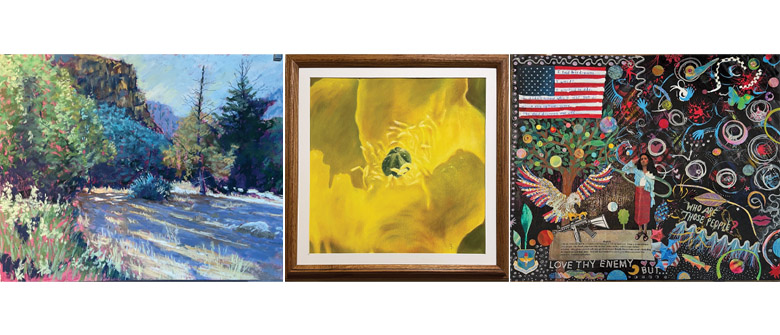

((Left) Eagle Canyon Morning by Paul Kneece, (Middle) A Look Inside by Jennifer Ramerman, (Right) In Memory of a Teenager by Cazandra Aporbo)
Long before Billy Woodruff entered the Army, he knew what he wanted to be. Whenever adults asked that familiar childhood question: What will you be when you grow up? His answer never wavered. “An artist.” High school graduation happened and then the Army where Billy discovered there was plenty of work for a young man who knew how to draw. His artistic ability kept finding its way into his assignments. At one posting, he painted a large mural depicting the history of his battalion. His fellow soldiers had constant requests. They handed him photos so he could draw portraits of their girlfriends. “I made a lot of money doing that!” Billy remembers.
The story still makes him smile but look at one of his portraits in the gallery: the delicate charcoal modeling of a cheerful face, the softness of the hair, the attention given to the eyes and mouth, and it’s easy to imagine those young soldiers lining up.
Billy is just one of the veterans whose artwork is featured in a special exhibition running from through November 28 at the Dry Canyon Arts Association (DCAA) gallery. Their pieces will hang alongside work by DCAA members. As 2026 marks the 250th anniversary of the United States, veterans who have all given some portion of their youth, time, freedom, family, life, safety, and talents to serve the greater good deserve a public venue where they can share some of their creative efforts with the public.
Less than one percent of Americans serve in the military. As we know, these brave individuals put their lives on the line, gain special training, and leave the military with memories or injuries that take a toll on their minds and bodies. Creating art is one way some veterans grapple with experiences so deep that they defy mere words. Billy understands that pleasure. After leaving the Army, he used his VA benefits to attend college and earned a degree in graphic design. He became an art director for a large television station and later opened his own studio, spending more than 30 years working with national and international clients. His career carried him around much of the world.
Retirement has given Billy more time for painting and drawing, especially the mountains he once climbed. In one landscape, immense gray cliffs rise above sweeps of snow, evergreens darkening the foreground while a turquoise sky breaks through behind the peaks. The mountain has weight. It seems insurmountable. “I love to paint mountain landscapes,” Billy says. “I used to be a very active mountain climber. Now I can only paint them.”
Cazandra Aporbo arrived at visual art by a different route. She joined the military at 17 and served at Kingsley Air National Guard Base in Klamath Falls. After Basic Military Training, she was sent to Keesler Air Force Base in Biloxi, Mississippi, for technical training just as Hurricane Katrina was bearing down on the Gulf Coast. While thousands of people were fleeing, Cazandra was heading in.
She remembers being “very young, very far from home,” suddenly surrounded by an unthinkable crisis where her help was needed 24/7. Now she knows that the experience affected her creativity more than she understood at the time. For much of her life, Cazandra expressed herself through writing and private reflection, but it wasn’t enough. She found visual arts offered another way to express herself.
Her collage Memories of a Teenager, includes bold-colored planets and spirals tumbling among hands, leaves, an eagle, a tree, military imagery and a figure of Cazandra herself. An American flag holds fragments of a childhood story: I had big dreams. I wanted to fly. Near the bottom sits the silhouette of a rifle. Elsewhere, among the color and commotion, a question appears: Who are those people? And along the lower edge: Love thy enemy. Nothing has been tidied up. Beauty and violence, childhood and adulthood, patriotism and questioning beautifully occupy the same piece.
Today Cazandra is an accomplished AI engineer who works with cutting-edge technology to make sure AI is safer for adults and children. Art has led her toward what patterns and algorithms cannot account for. “Meaning,” she says, “comes from memory, experience, contradiction, emotion and from all the strange and beautiful things we carry with us.”
Cazandra doesn’t describe her art simply as healing. It’s closer to finding a physical form for things that intellectual explanation cannot quite contain. “At some point it only makes sense to come to terms with who I was at the time and to create something from it.”
Jennifer Ramerman also joined the Army at 17, right after high school. She decided to become a Geospatial Intelligence Imagery Analyst. She examined aerial photos taken by drones to spot enemy forces, map them, and then provide tactical intelligence to commanders. During Basic Training, she was among the first company of women who underwent the same physical fitness requirements as men. She trained at Fort Huachuca, then moved to Fort Ord in California and ended up at Fort Lewis outside of Tacoma, Washington. “While up at Fort Lewis, I was able to go up in a helicopter with the doors off, and we would look for infantry troops out on the bivouac. I would share photos I took with commanders to show what we found. That began my lifelong love for photography.”
Jennifer’s artistic life blossomed after retirement from a 30-plus year career in healthcare and a move to Central Oregon. Watercolor came first, followed by pastels, colored pencils, photography, stained and fused glass, and most recently clay. But curiosity led Jennifer to an especially intriguing marriage of painting and glass that she learned from artist Mel Archer: she mixes powdered glass with essential oil, brushes it onto sheets of glass, then fires the image in her kiln. “Being part of Redmond’s art community has truly been a gift.” In the gallery, Jennifer’s luminous pastel painting, “A Look Inside,” captures yellow petals unfolding from pools of golden amber around a dark, intricately painted center.
Marine Corps veteran and SageBrushers member Paul Kneece spent years sketching before taking up painting in his mid-40s. “As a pastel painter, I paint moments that try to show the light on a landscape. I hope my work gives viewers a feeling of time and space.” In Eagle Canyon Morning, light seems to shimmer as violet-blue shadows spill across an open path while turquoise, green and flashes of rose move through the trees. In the background, a dark, distant cliff acts as an anchor for all that color. “The concentration of looking closely, then looking even closer, helps bring balance to me.” Uniforms tell us something important about the brave and selfless people who wear them, but their art expresses the exploration of human souls searching deeper.
See these and other veterans’ work on display from through November 28 at the Dry Canyon Community Art Center at 415 SW Sixth St. in downtown Redmond and join the artists at the opening reception during First Friday, October 2, between 5-8pm.