
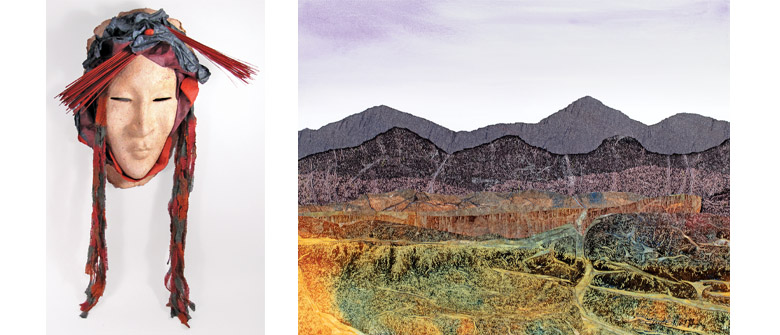

((Left) Asian Reeds by Debra Fisher (Right) Watercolor by Linda Wolff)
Wolff, who lives in Sisters, details landscapes and abstracts using paper and watercolors. Fisher, from Bend, casts facial masks from paper. “We are featuring these two artists together in an exhibit designed to highlight the many ways paper can be manipulated to create art,” said gallery owner Helen Schmidling. The Many Faces of Paper exhibit runs from the fourth Friday in September through October.
Wolff has been showing her work in Sisters Gallery for four years. This is Fisher’s first time showing her work at the gallery, though she has been featured in this same location (222 West Hood Avenue) under prior gallery ownerships.
“It is very challenging to turn white tissue paper into colorful collage, as each piece is unique, based on the watercolor skies and the mixture of fluid acrylic paints used for the rest of the picture,” Wolff says. “It’s an intuitive process that captured my interest 11 years ago as a creative outlet that replaced Dahlia gardening when I moved to Sisters, where the deer feasted on the flowers as though it was their own private smorgasbord.”
She starts by covering a large sheet of strong cardboard with butcher paper and then covers that with white tissue paper. Sometimes the entire board is one piece of tissue paper, and other times it’s layered with shapes — mountains, rivers, or abstract shapes torn in advance. Then she spaces two or three strips of crepe paper horizontally across the tissue paper before misting the entire paper with water.
Then the magic commences.
She either paints the shapes with watered down acrylic paints or mixtures of Golden fluid paints. Working over a large sink, she pours the paint onto the paper “canvas,” moving it around to create the unique blend of colors that magically appear. Each shape, each texture, absorbs paint in its own fashion.
Then she waits.
She places the paper canvas aside to dry indoors, or outside if it’s warm enough. When the piece is dry, she peels it from the butcher paper.
This is when she begins to create the image.
Working on a sheet of 300-pound watercolor paper, she begins a landscape or abstract image. Sometimes she paints the sky with watercolor. Otherwise, the sky is formed from a new piece of the unique colored paper (think sky-blue-pink, sunset oranges, or deep blue). At this point, she can add the skeleton of prickly pear cactus or tree bark for texture, if appropriate.
“I never know how the landscape will evolve. It is challenging to play with different shapes and sizes to reflect Nature’s changing color as the light rises and sets on the canvas. The uniqueness of each piece of paper determines what will present itself as I glue one piece of paper onto another.”
Some images appear as straightforward landscapes, while others manifest as underground caves and tunnels. Some are completely abstract. There are multiple layers of color and texture.
Fisher has loved making things since childhood. She discovered the magic of masks when a local theater asked her to make witches for Eugene Ionesco’s “Macbett,” a free adaptation of Shakespeare’s “Macbeth.” As the witches came on stage, there was a collective gasp from the audience! She was hooked and has made masks and costumes ever since.
As a freelance artist Fisher has balanced her career as a costumer, working artist and teacher for over 30 years. She has worked for The Oregon Shakespeare Festival, Portland Center for the Performing Arts and Magic Circle Theater.
Fisher specializes in costume props, hats, helmets, masks, armor and footwear. She is an OPB ArtBeat Alumni and an Oregon Arts Commission grant recipient for innovative and collaborative youth programming. She has traveled extensively as a teacher for the Oregon Arts in Education, sharing the arts with thousands of students and teachers throughout the Northwest.
“Masks are unique objects, and one of the first human art forms. It is a thrill to experience the illusion of transformation masks create,” Fisher says. “Masks can spark the imagination and transport the wearer and viewer into a world of mystery. Masks seem to have a life of their own, one that extends beyond the maker’s hands. As a mask maker, I am deeply honored to be a conduit for such a magical art form.”
Over the years, Fisher has enjoyed experimenting with a variety of materials and approaches — paper being the most versatile, flexible, affordable and renewable. It can be cut, fabricated and cast into molds depending on the type used.
Her current works are mold cast Paper Maché faces dressed with handmade paper and natural elements. Each face is sculpted in clay, then a plaster negative is made. The paper is then cast into the mold. When dry, the face is trimmed smoothed and decorated.
Fisher also designs and fabricates leather masks for specialties such as Renaissance Fairs. Her book, Animal Mask Making, is a step-by-step approach to creating paper masks for teachers, families and theater groups. The book is available at The Stitchin’ Post.
Both artists will be at Sisters Gallery and Frame during the September 25 Fourth Friday Artwalk, from 4-7pm.