
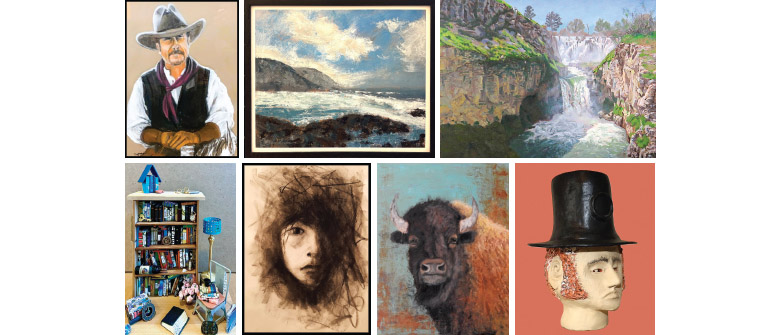

((Left to right, top to bottom) Cowboy Hero by Joan Sheets, Yachats Bay by John Goodman, White River Falls by Krystal Allen, So Many Books V5 by Kelley Salber, Charcoal Portrait by Michelle Oberg , Bison-Acrylic by Susan Lees-American, Abraham Lincoln by Walter Troutman)
There are places you intend to visit, and places that surprise you into staying longer than planned. Dry Canyon Community Art Center has become the second kind. In downtown Redmond, where restaurants, shops and First Friday foot traffic are giving the city a livelier evening pulse, the gallery has begun to feel like more than a new address for art. It has already become a new community treasure. Something is gathering here: talent, energy, conversations, classes, volunteers, visitors and the kind of blooming civic imagination that enhances how a town sees itself. It is a hub where everyone can participate — seasoned artists, art by local students, creations by veterans, and next month, a show featuring citizens from Redmond and the neighboring counties.
Step inside and the first impression is range. Glass catches and throws the light. Ceramics hold their forms with quiet authority. Paintings in oil, acrylic, pastel, charcoal, watercolor and mixed media create a lively exchange across the walls. Wood, collage, sculpture and jewelry all add texture and dimensionality. Nothing about the gallery feels accidental. The work is exciting and varied, but the standard is clear.
One visitor recently said, “I heard about this gallery, and I wasn’t sure what to expect. The content is better than most all galleries I’ve visited on the West Coast.” An artist from Florida, Illiana Avalos, makes a point of seeking out local art communities when she travels; “This gallery has such an incredibly wide array of creative work. The quality of the work is truly inspiring.” Monica Huey, a local Redmond artist who just joined Dry Canyon Arts Association, said, “I’m impressed by how many talented and productive people there are in the area. Each month, there is a new featured artist, and I see all new work! It’s exciting and impressive.”
The current America the Beautiful exhibition lets artists answer the theme from many directions. America appears as landscape and symbol, yes, but also as memory, diversity, resilience, family, labor, imagination and the quiet hope where every story might find its place. That hope is beautifully embodied in Kelley Salber’s three-dimensional miniature bookcase, So Many Books, Volume 5. Created for this exhibition, the work reflects America’s enduring love affair with books and the stories that shape our culture. But Salber deepens the metaphor. Each miniature book represents a person, because every person carries a singular story and every life, as she says, is a good read. The bookshelf becomes a portrait of human connection — a place where challenge, beauty, discovery, transformation, purpose and destiny stand together.
Susan Lees’ American Bison honors an animal woven deeply into the history of the plains. Once nearly unimaginable in number, bison now stand as symbols of resilience and ecological restoration. Lees celebrates the individuality inside the icon: the subtle color variations and beauty in the eyes that make each creature distinct. Her painting asks us to look again at something we think we already know.
R.J. Becker’s Eagle also begins with a national emblem, but the painting is rooted in lived experience. Raised in Alaska, Becker grew up in a place where eagles’ wild majesty were part of daily life. Krystal Allen’s oil painting White River Falls brings a different kind of magnificence. Water crashes down two cliffs with force and power, which, to Allen, depicts our country’s rich resources but is also reminiscent of the human spirit this country was founded upon and continues to demonstrate to this day.
Walter Troutman’s ceramic Abraham Lincoln examines our country’s history and leadership. Trout was inspired to sculpt Lincoln because he sees him as a people’s president, a figure who truly helped this country’s progress. Nearby, Joan Sheets’ pastel American Cowboy Hero celebrates another American figure: the cowboy as capable, wistful, weathered and strong. Sheets paints not only the romance of the West but the toughness required to live there, giving her cowboy the look of a man who can do almost anything.
Michelle Oberg’s Charcoal Portrait considers the nation through the diversity of its people groups. John Goodman’s Yachats Bay brings the theme home to Oregon relating to his memories of family vacations on the coast.
This is a show you won’t want to miss. Hours are Tuesday-Saturday, 11am-6pm.