
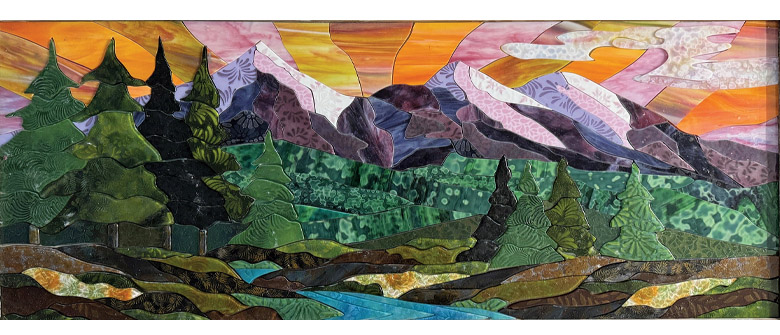

(Three Sisters Sunrise in progress, 54×21 powder-printed fused glass and stained glass mosaic by Jesica Carleton)
Early afternoon sun pours through two large studio windows in Bend. Outside, an expansive yard is curated with sculptural garden stakes, rainbow glass tiles and mosaic sculptures. Inside, jewel-toned window panels reflect the light, and a vibrant assortment of colored glass pieces glints from jars and bins. Jesica Carleton’s design table holds a lineup of works in progress, from delicate hearts and birds to bold, architectural mosaics.
This isn’t just a workspace; it’s a celebration of curiosity, color, precision and play. Carleton’s mosaics, glass-on-glass panels and metalwork, blend function and beauty – pieces that not only decorate a space but change the light within it. “The goal is simple – to make people smile, to make their eyes keep moving, to help them find more joy the longer they look,” she says. Her vision calls for variety, experimentation and adventure in every piece.
Aside from the kiln, the waterjet cutter and other tools she uses, Carleton’s process is refreshingly hands-on. Her work is both tactile and meticulous. She sorts glass by hue and texture, test-fits each shard, grinds edges smooth and hand-places components until the composition clicks. Silicone adhesive then makes the vision permanent. Her signature fused-glass mosaics – using her own powder-printed glass technique – can take weeks of careful assembly. “But when these pieces hang on the wall and catch the light,” she says, “it’s all worth it.”
Carleton admits she can’t stop the stream of creative ideas that come into her mind every day. “I always have at least six or eight things going at once,” she says. “I can’t imagine making the same piece repeatedly. Some artists create one design and replicate it a hundred times – it sells, but that’s not for me.”
That sense of adventure meant Carleton explored many artistic mediums before finding her love for glass. “I was a quilter for years,” she says, “which taught me to balance bold patterns with precise construction.” When she bought her first house and wanted garden art, she couldn’t afford much, so she began making it herself. Early experiments using ceramic tile and thrifted dishes broken into pieces led to projects that didn’t always work – like a tiled bowling ball that met Alaska’s freeze–thaw cycles head-on. “In spring, it was just a naked bowling ball surrounded by loose tiles,” she laughs. “That’s when I realized I had some things to learn.”
Glass quickly became her favorite medium. “Saturated color – nothing else moves me quite like it. Glass has this energy where the light does the work and makes it sing.” Carlton isn’t daunted by the science involved. Firing depends on thickness, layering and timing, and if the kiln schedule is even slightly wrong, the glass can crack. When her first large, fused piece did crack, she salvaged the fragments and transformed them into a new composition. In her workshop, there is never any waste. Every shard holds possibility.
Technology now plays an important role in her process as well. Using design software like Inkscape, Carleton develops intricate patterns that can be cut with a laser or waterjet before being assembled by hand. The tools save weeks of planning and cutting. She now shares that knowledge by teaching Inkscape design classes at the DIYCave makerspace in Bend, along with workshops in mosaic and fused glass at a few other locations.
Teaching has become an important part of Carleton’s artistic life. “One of my favorite things about mosaic is how accessible it is,” she says. “Even people who believe they’re not artistic can create something beautiful. I love helping people discover their own creative potential.” At the same time, she acknowledges the realities of being a working artist. “Materials are expensive and time is finite, but I never want to lose the joy of experimentation.”
Carleton’s independent creative spirit began early. In third grade, an art teacher criticized her for drawing a tree “wrong.” Her mother promptly marched to the school to defend her daughter’s imagination. That freedom to explore became the throughline of a body of work that now includes jewel-toned window panels, mosaic mirrors, birdbaths, fused-glass wind chimes and large metal-and-glass sculptures.
With strong creative impulses throughout her life, Carleton has explored a wide range of artistic media, including sewing, paper quilling, batik, calligraphy, ceramics, acrylic pour painting, alcohol inks, sculpture building, cement casting, printmaking, collage, watercolor, Japanese brush painting, polymer clay, epoxy resin, woodworking, welding, glass fusing and mosaic art. Through every medium, she says art has remained her grounding force and a source of healing.
Her advice to new artists is simple: start with what you have – even thrift-store plates – and don’t worry about doing it the “right” way. “Just be warned,” she says with a smile, “it’s addicting. There’s something magical about shaping color and coaxing beauty from broken fragments.”
Collectors can find Jesica Carleton’s work at the Artists’ Gallery Sunriver and the Dry Canyon Community Arts Center in Redmond, as well as at venues participating in the Dry Canyon Arts Association’s Lend Me Your Walls program. More information about her work and classes can be found through her website, Carleton Manor Mosaics.
Dry Canyon Arts Association is proud to present Jessica Carltons’s work as the Featured Artist during April at the Dry Canyon Community Art Center. The public is invited to attend a reception in his honor at the Art Center on First Friday, April 3, from 5-8pm.
Dry Canyon Arts Association is a 501c3 charitable organization listed with the Oregon Cultural Trust. Federal EIN # 20-1326201 Oregon State Registry # 22907-90