
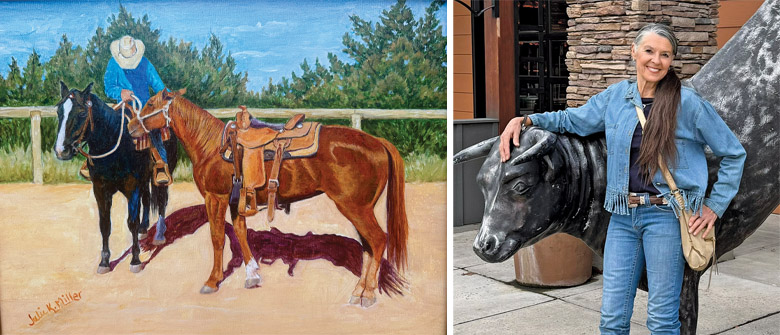

Stand quietly in front of one of Julie K. Miller’s paintings and something unexpected begins to happen. At first, you notice the obvious things — the gleam of a horse’s chestnut coat catching afternoon light, the careful architecture of muscles beneath skin, the confident tilt of a cowboy’s hat, a line of horses lowering their heads to drink beneath an immense Western sky. But if you linger another moment, the paintings begin asking for something different. They ask you to slow down. To listen. To notice the invisible conversation unfolding between horse and rider, between animal and landscape, between strength and gentleness.
For Julie, that conversation has lasted a lifetime. She often traces it back to a memory from childhood that has never loosened its hold on her imagination. Born in Budapest, Hungary, in 1954, Julie was only two years old when her family fled the Soviet occupation and sought a new beginning in England. While camping in the countryside when she was five, she encountered a small donkey grazing quietly in a meadow. Her father lifted her onto its back. “It felt like flying,” she remembers. “Freedom, exhilaration, love.”
Almost immediately, horses began appearing in her drawings. School papers, notebooks, anything that would welcome a pencil soon carried sketches of horses. Long before she understood that art could become a vocation, she understood that horses would become her language.
When her family immigrated again, settling in California’s Bay Area, that language expanded. The region still held working ranches tucked among rolling hills, and Julie eagerly learned to ride, immersing herself in English disciplines including jumping and dressage while studying fine art through school and college.
Like many artists, however, Julie’s life first carried her in an unexpected direction. She built a successful career designing semiconductor chips for Intel, a world measured in precision, engineering, and microscopic accuracy. Yet even while technology occupied her weekdays, another part of her life refused to remain in the background. Horses still filled her weekends. Sketchbooks continued filling with studies of movement, anatomy, expression, and light.
Eventually, the balance shifted. Julie left Silicon Valley behind for California’s remote Modoc County, where ranches stretched across open country and the rhythms of weather, livestock, and seasons shaped everyday life. Here she found herself surrounded by the subjects she loved most. Deer wandered through the sage. Coyotes drifted along distant ridges. Hawks rode invisible currents overhead. Cowboys gathered cattle beneath enormous skies that seemed to stretch forever.
For an artist, it was impossible not to see. Yet over time, Julie realized she wasn’t merely interested in painting wildlife or Western life. She wanted to capture relationships. Years spent training horses taught her that every ride depends upon silent conversation. Confidence and trust grow one quiet decision at a time until horse and rider begin moving almost as one creature. That understanding quietly animates every piece she creates.
Her graphite drawings possess remarkable restraint. Rather than relying on dramatic effects, they allow careful draftsmanship to tell the story. In Down the Fence, a cow horse pivots with breathtaking athleticism while a calf lunges forward; yet nothing feels frantic. Every muscle serves a purpose. Every shadow deepens the illusion of weight and motion. Even the dust seems to breathe. In this way, her paintings embrace atmosphere.
In Miss America, a chestnut horse trots directly toward the viewer through shimmering golds, lavenders, and blues. The colors are less descriptive than emotional, inviting us to experience the horse’s quiet confidence rather than merely admire its form. Another painting gathers horses at a watering hole where reflections dissolve into rippling color. There is no drama, only peace — a reminder that stillness can be every bit as compelling as speed.
Throughout her career, Julie has worked in acrylic, watercolor, charcoal, pastel, graphite, colored pencil, and mixed media. Although her style began in careful realism, it has gradually opened toward greater expression. Color has become bolder. Backgrounds have loosened. Movement has become as important as anatomy. Yet realism never disappears completely because respect — for the horse, for the land, for the traditions of horsemanship — remains at the center of everything she paints.
Now living in Central Oregon, where she has resided with her husband for ten years, enjoying adult children and grandchildren, Julie continues balancing art with the practical realities of caring for four horses, three dogs, a cat, and five acres. It’s a full life measured as much by feeding and caring for animals and watching weather roll across the Cascades as by hours spent at the easel.
Julie’s paintings remind us that beauty is never merely something we observe. Sometimes it carries us and lifts us into higher understanding. And sometimes, if we are fortunate enough to remain still long enough, it teaches us how to listen.
See Julie’s work on display all month at the Dry Canyon Community Art Center at 415 SW Sixth Street in downtown Redmond, or join her at the Art Center for a celebration of her work during First Friday, September 4, between 5-8pm.