
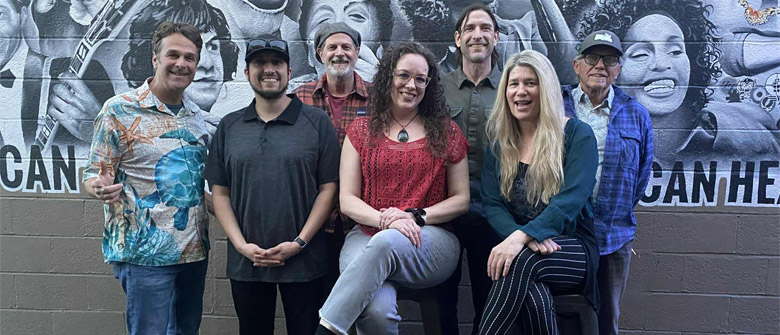

(Photo courtesy of Trickster: A Community Band)
Featuring:
Mark Ransom (The Mostest/GBots/Bend Roots): guitars and vocals Mai Hyman (Oregon Fryer): banjo, dobro, guitars, and vocals Wendi Wampler (Jeshua Marshall & The Flood): clarinet
Mike Beaulieu (Shady GroOove): upright and electric basses
Laura Fieberg (Stealhead/Soul-Sistaahs): vocals Jen Lande (Pounce/Soul-Sistaahs): vocals and guitar Dylan Bernal (Rusty Frets/Sonic Benders): drums
Kent Howes (Critical Blues Band): percussion and vocals
What to expect:
A large-band dance-and-sing-along evening of fun, familiar classics from artists like Janis Joplin, John Prine, The Rolling Stones, Bob Dylan, Smokey Robinson, Wilco, Johnny Cash, The Band, Neil Young, Guy Clark, JJ Cale, Jerry Garcia, and Merle Haggard to name a few. The group will also showcase a few original songs penned by resident songwriters Lande, Howes, Ransom, and Hyman. Expect danceable grooves mashing-up folky-blues with country, classic R&B, southern rock, and San Francisco psychedelia.
About the players:
Mark Ransom is a prolific singer-songwriter and guitarist who moved to Bend 1992. He is known locally as a music instructor, leader of The Mostest, and creative director of the Bend Roots Revival. Born into a musical family in the Midwest, Ransom did his undergrad at Colorado State University and recently earned a Ph.D. in depth psychology from Pacifica Graduate Institute. His dissertation focuses on the practice of arts-based psychotherapy and why the world needs music now more than ever. He teaches music at Westside Village Magnet School.
Matthew (Mai) Hyman was born in Appalachia and raised in Oregon. Though he writes, teaches, plays and sings many styles, his roots in old time and bluegrass shine through. While Mai shreds the electric guitar (with nods to great southern rockers like Billy Gibbons and Duane Allman), his diversity and subtle sensitivity come through on banjo and dobro. Mai was a founding member of Moon Mountain Ramblers—a band which helped define Bend’s music scene—and he is also known for his work with Oregon Fryer: Central Oregon’s favorite progressive, alt-country dance outfit.
Wendi Wampler’s musical journey became nuanced and more complex as she dove into a practice of belly dancing. As a musician trained on clarinet, Wampler was drawn to the rhythms and melodies which belly dancers embody—and the extemporaneous nature of this style of music. Though Wampler is steeped in Middle Eastern and Eastern European music, she is equally at home in the world of New Orleans jazz, funk and soul. A core member of Jeshua Marshall & The Flood, Wendi holds a Ph.D. in Physics and is a professor at Central Oregon Community College.
Mike Beaulieu’s original style emerges from the borderlands between Don Was (Bobby Weir & Wolf Bros) and Phil Lesh (Grateful Dead). He brings a playful bounce to Trickster with his melodic bass playing and curious attitude—alongside 50 years’ experience, live and in the studio. Mike is known locally as the driving force behind Shady GroOove—an instrumental tribute to the Grateful Dead. He is also a frequent collaborator with artists like John Shipe, Travis Ehrenstrom, and Brave New World. Recently retired from his day job and jamming all the time, Beaulieu teamed up with Ransom to create the musical foundation for Trickster.
Jen Lande, known as Lande, is an indie rock/pop-punk singer-songwriter inspired by the rebellious spirit of 80s and 90s music. Her latest project, Pounce, is a disco-infused dance-punk band known for high-energy sound and irresistible rhythms. Author of two full-length original albums, Lande is an avid musical collaborator and co-composer. She has earned praise for her intuitive harmonies with (fellow Trickster) Laura Fieberg in the Soul Sistaahs—a singing duo-for-hire who have worked with many local bands including Shady GroOove and Call Down Thunder.
Dylan Bernal is one of Bend’s most sought-after drummers. A welcome transplant from Southern California in 2017, Bernal has since played with many of Central Oregon’s finest players—including Eric Ledbetter, Gabe Johnson, and The Mostest to name a few. Local musicians and music fans appreciate Bernal for his kindness as a human and his sensitive but commanding agency on the drums. The groove is always tight, the tempo rock-steady, and the volume dynamic. While Dylan is comfortable performing all styles, he grew up immersed in a fusion of reggae and west-coast punk rock, with a deep appreciation for pioneers like Bob Marley and Sublime.
Music found Laura Fieberg at a young age as she was pulled into musical theater. Her passion for singing carried her into young adulthood where she spent countless nights honing her voice at karoke. After moving to Bend she connected with Lande and began singing backup—which opened the door to performing regularly in the local music scene. She has since collaborated with several well-known Bend bands including Call Down Thunder, Stealhead, and The Mostest.
Fieberg is a versatile and dynamic background singer who will blow you away whenever she takes the lead!
A product of Minneapolis funk and soul with a degree in music from the University of Minnesota, Kent Howes is a percussionist and singer who moved to Bend in 1992. Since then he has worked with many local acts both live and in the studio. Howes’ influences range from Prince, Parliament, and Dilbert McClinton to the Latin jazz of acts like Stan Getz and Herb Alpert. A well-rounded and seasoned pro trained on drum-set and hand percussion, Kent shines as a soul-singer and master of the timbales. Howes and Ransom first joined forces twenty years ago in a group called Outside Dog and then again more recently in Victory Swig. Kent is also a member of Bend’s Critical Blues Band.
A Group with Experience, Talent and Intent:
Trickster is an eclectic mix of talented local players and singers who have joined forces to honor and further the American Roots Music Tradition—for its power to bring joy and relatedness to the world. Immersion in this tradition brings joy and a sense of community as we sing along and dance. Obviously, this is what many of us love about music in general. But research shows how paying close attention to this ritual, to these musical forms, can take us much deeper—through some great aspects of our history and also to what and who has been marginalized in our 250-year pursuit of greatness.
This path leads all the way back to our ancestors—to their old-world and indigenous wisdom and even to an enchanted experience of “Music herself,” as Victor Wooten maintains. Many greats like Oteil Burbridge, Kenny Werner, John Batiste, Derek Trucks, & Mickey Hart (to name a few) insist that immersion in this ritual allows the ancestors to play though us.
Just the other day our friend Andy Armer mentioned that during his practice session it seemed like Tom Petty was there playing guitar licks on Andy’s piano. No shit. The juke-joint scene in the movie Sinners depicts this experience beautifully as musical ancestors join with musicians of the present and future to lead the jam.
How do you think the world might change if we all got a taste of this “magic,” as Burbridge calls it? How might deep curiosity and wonder change the world? Sure, it’s about the revelry of us so-called “sinners,” but it is also about learning how to soften our resistance to what might seem “other.” The musicians (and the audience) invite the other to join-in during this ritual, and who could be more other than a disembodied ancestor?
Even for those of us who simply appreciate music and aren’t interested in magical enchantment, if we follow our music history back to New Orleans (the birthplace of American music) and listen closely, we are confronted by the fact that American music is as much West African, Latin and Indigenous as it is European. Re-membering Western culture’s fragmented past through the beauty of music can be transformative because from this aesthetic vantage point we are more likely to recognize and retract projections about what American music (and America) is, than we are to double-down on the fear and hate that seems to always accompany othering in general.
Ransom, who holds a Ph.D. in depth psychology, maintains that for every effort made in the therapy room an equal or greater one needs to be made engaging the collective. This is because “Many of our individual struggles stem directly from being conditioned in and by a fragmented culture. No matter how many therapy sessions I have, why should I expect my anxiety and fear to subside if every day I live and work in a fearful, standoffish society? Racism, misogyny, queer-fear, and ecological destruction are all rooted in a style of consciousness which denies differentiated beauty. We need more practices like this one, which open hearts through aesthetic eyes and ears.”
Appreciating the beauty of different styles of music, we learn to tolerate different perspectives we might otherwise fear and resist. We can even become attracted to what is different. “It is the realization of likeness through aesthetic difference,” according to Ransom. Instead of fearing the other we move curiously toward it for its unique, awe-inspiring, and differentiated beauty.”
Trickster: What’s in a Name?
In cultures around the world we encounter images of the Trickster. In the ancient Greek tradition, there is Hermes, whose Roman equivalent is Mercury. So right away you see we are copying Faruk Bulsara who took the stage-name name Freddy Mercury. Or, as the members of Trickster see it, both we and Faruk had a similar inspiration at slightly different times. Freddy was queer in a very straight world—calling out a very straight queen and everything the colonizing world stands for. The beauty of his music dissolved mainstream resistance to the otherness of queerness—a little bit—and tapped at the door of our blind spots.
Tricksters live in the borderlands between worlds, images, ideas. Hermes/Mercury can travel to the Underworld and back and then soar to Mount Olympus. Known as messenger of the gods it is safe to say the Trickster is present in all forms of communication. His style is youthful, playful, and contrary—like any self-respecting rock n roller. Willy Wonka was a Trickster. Jerry Garcia embodied Trickster energy too. In some indigenous groups of North America, the Trickster is portrayed as a coyote—a figure who moves between night and day worlds. Like any affective piece of art, the Trickster has the ability to show us our biases and make us more open to the other.
Trickster: A Community Band
April 11
7:30-10pm
Silver Moon Brewing
$10 at the door