
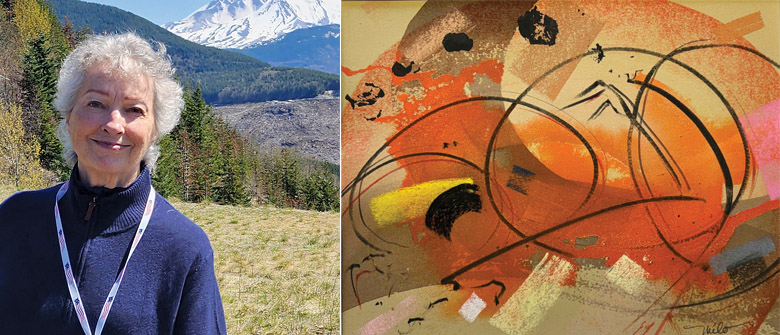

(Silence in Movements by Molly Freitag at St. Hemens)
Molly Freitag, a longtime Central Oregon artist and chaplain, paints abstractions that shimmer between landscape and inner life, between sky and cell, and between river current and nerve current. It’s important to Molly that her paintings do not sit still. They open. They suggest. They keep becoming. In her own words, “They’re abstract with an organic quality about them, and can be seen as evocative of galaxies, skies, water environments, a microscopic view or pathways of change through fields of light and movement.”
While Molly has been painting for 20 years now, her life in art has unfolded across decades and disciplines. Her training includes Ventura College, the San Francisco Art Institute and the Fine Arts Center School at the DeYoung Museum, followed by years of classes, workshops and parallel creative work in clay, costume design, calligraphy and watermedia. Her life in service has been equally substantial: chaplaincy training, hospice work, art therapy, bereavement classes, public speaking, spiritual writing and the practical, tender labor of helping people live through illness, grief and change. She has also been active in regional arts communities for years, including exhibitions across Bend, Redmond and Prineville, work with the Watercolor Society of Oregon, and more recently writing about art therapy in the Dry Canyon Arts Association’s newsletter.
That double vocation – artist and chaplain – matters. It’s the pulse beneath her work. She’s not trying to overpower the viewer with a message; instead, she’s trying to make room for an encounter. “As a painter and chaplain, I believe in nourishing others with an intent to create ‘healing environments’ that treat the mind, body and spirit. Art is experienced emotionally. I’m aiming for feelings that are subtle and life-affirming.”
Molly’s paintings often begin with “a simple watercolor wash,” and then unfold in “a call-and-response to what’s on the paper.” Sometimes the final touches come through calligraphic mark-making, a detail she compares to “a handwritten note or small poem.” She speaks of “searching for gateways to the inner spirit … to origin,” and says her process is “always accompanied by high-risk and passion.”
Embracing that watermedia can feel less like control and more like collaboration, Molly loves watermedia “because it’s very unpredictable and unplanned.” Her paintings, she says, “contain a metaphor for life: you can plan, but there’s so much you can’t control that happens spontaneously.” That insight gives her work its emotional charge. These paintings are not illustrations of serenity made from a distance. They’re immediate negotiations with deep knowing. They admit fluidity and change. They let surprise into the room.
Her influences nod toward the kinetic and ungovernable – artists like Willem de Kooning, Cy Twombly, Sam Francis, Joan Mitchell and Robert Motherwell – yet Freitag’s language is unmistakably her own. Color speaks first. Gesture follows. Negative space becomes an instrument, too, creating the pause that lets a note ring. She works to music, and it’s no wonder the Japanese notion of impermanence and imperfection appeals to her – wabi-sabi as an ethic and an energy, as if a painting contained the trace of a dance done once, wholly, and then expanded beyond boundaries.
Molly describes herself as “a ‘colorist’ at heart,” and says her paintings are “experiential images… abstractions of nature.” They are “not descriptive, literal or narrative, yet compelling and adventurous in discovery and transformation.” In that sense, Molly “Milo” Freitag’s work offers something increasingly rare: art that is exploratory without being obscure, spiritual without being didactic, intuitive without being careless. It’s art shaped by skill, patience and years of attention – to color, to material, to suffering, to the delightful moment where chaos and form meet.
Molly’s reach is both intimate and communal. Other than prestigious galleries, her pieces have hung where people need them most: in hospital corridors, in waiting rooms, in places where color and softness can act as a steadier of breath. She’s a long-time member of the Watercolor Society of Oregon, a frequent participant in critique groups, and a tireless student –
someone who still greets the blank page with curiosity rather than certainty. It’s the mark of a life attuned to mystery.
She hopes those who see her art will feel the hand and heart at play and experience a sense of their own life’s ways of change and movement. “If the paintings continue to move silently within their frames, evoking the rhythms and cycles of life like a series of breaths, there will be the sense of completion.”
See Molly Freitag’s work on display all month at the Dry Canyon Community Art Center at 415 SW Sixth Street in downtown Redmond or join her at the Art Center for a celebration of her work during First Friday, May 1, between 5-8pm.